Hedge trimming after nesting season: what you can cut now in Nottinghamshire and Lincolnshire
Nesting season is over in Nottinghamshire. Here's when and how to trim your hedge safely, legally and well, from Newark to Grantham and beyond.

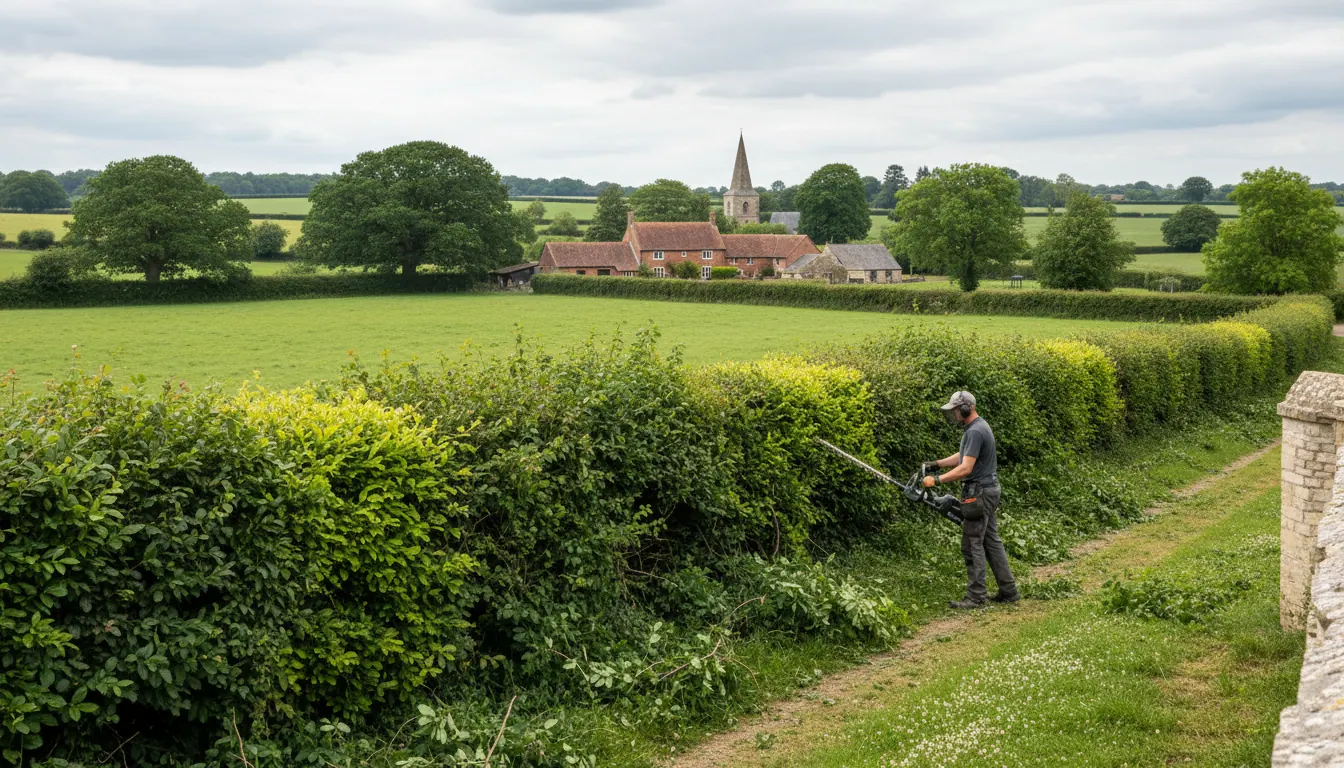
The nesting season window has closed. Now the real hedge work begins.
From September onwards, gardens across Nottinghamshire and Lincolnshire start to look a little wild. Hedges that have been left alone since late winter, quite rightly, while birds were nesting, are now thick, leggy and often blocking light. This is the moment to act.
Nesting season runs from March through to the end of August as a general guide. During those months, cutting hedges that contain active nests is an offence under the Wildlife and Countryside Act 1981. Once September arrives, the restrictions ease significantly, though you should still check for late nesters before you start any work. A quick visual inspection costs nothing and keeps you on the right side of the law.
We cover the whole area from Newark-on-Trent out to Southwell, Collingham, Bingham, Lincoln, Grantham and Sleaford, and this time of year is one of our busiest for hedge trimming. Here is what you need to know before you pick up the shears or call us.
Why September to November is the best time for hedge trimming in Nottinghamshire
Timing matters more than most people realise. Cut too early and you risk disturbing late-nesting birds. Cut too late in the year and the hedge may not have enough time to settle before the first hard frosts arrive.
The late-summer to mid-autumn window is ideal for several reasons:
- Growth has slowed down, so a trim now holds its shape well into spring.
- The hedge is still in leaf, which helps you judge the shape and density accurately.
- Any minor cuts and wounds close before winter sets in.
- You are not cutting into fresh spring growth, which wastes the plant's energy.
For most common hedging species in this part of the Midlands, privet, hawthorn, beech, hornbeam, laurel and box, a good autumn cut followed by a tidy-up in late winter is the standard approach. Yew is slightly different (more on that below).
Which hedges can be cut hard back, and which need a gentler touch?
This is one of the questions we hear most often, especially from homeowners in Nottinghamshire who have inherited an overgrown garden or bought a property where the hedges have not been touched in years.
Privet is remarkably forgiving. Hard renovation cuts, taking the hedge back to within a foot or so of the main stems, are usually successful if the plant is healthy. New growth returns reliably, though it may take a full growing season to look respectable again.
Hawthorn and blackthorn are similarly tough. These are common boundary hedges across the farmland around Collingham, Southwell and the Trent valley, and they respond well to hard cutting. They do tend to throw up vigorous new shoots, so a follow-up trim the next autumn is often needed.
Beech and hornbeam hold their shape well but do not enjoy being cut back into very old, thick wood. Gradual reduction over two or three seasons is better than a single dramatic cut.
Laurel can be cut hard, but use secateurs or loppers rather than a powered hedge trimmer on thick stems. Shredded leaves look untidy and can encourage disease.
Conifer hedges, including leylandii, are a special case. The key rule is this: never cut back into the brown, dead wood behind the green growth. Conifers do not regenerate from bare wood the way broadleaved plants do. You can reduce the height and sides each year by taking off a small amount, but a hard renovation cut will leave you with a brown, dead hedge. If your conifer hedge has got seriously out of hand, it is worth reading our more detailed guide on conifer hedge and leylandii reduction: keeping your privacy screen without killing it before deciding how to proceed.
Yew is the exception that surprises people. Unlike most conifers, yew regenerates well even from hard cuts into old wood. A neglected yew hedge can be brought back over two seasons. Cut one face hard in year one, let it recover, then tackle the other face and the top the following year.
What about TPOs and conservation areas? Check before you cut.
Most domestic hedges are not subject to Tree Preservation Orders. However, if your property sits within a conservation area, and there are several across Newark-on-Trent, Southwell, Bingham and parts of Lincolnshire, certain rules about boundary features may apply.
More commonly, people have individual trees within or alongside a hedge that do carry a TPO. Cutting back a hedge that is growing into a protected tree, or removing a tree that has grown up within a hedge line, can require council consent.
Our advice: if you are in any doubt, check with Nottinghamshire County Council or the relevant district council before starting work. It takes ten minutes and saves a potential fine. We are always happy to advise on what we think needs checking before we quote for a job.
Boundary hedges and your neighbour's rights
A question that comes up regularly: can your neighbour cut the top of your hedge without your permission?
The short answer is that your neighbour has the legal right to cut back any branches or growth that overhangs their property, up to the boundary line. They do not need to ask you first. However, they cannot cross onto your land to do so, and they must return any cuttings to you (in practice, most people do not bother with the cuttings, but legally the trimmings remain your property).
If the hedge belongs to you and sits entirely on your side of the boundary, your neighbour has no right to cut it without your agreement. If ownership is shared or unclear, it is worth a polite conversation before anything else.
When to call us rather than tackle it yourself
A domestic hedge at head height, trimmed with a decent electric or battery-powered hedge trimmer, is a manageable DIY job for most people. But there are situations where it genuinely makes sense to bring in a professional:
- The hedge is over 2 metres tall and requires a ladder or working at height.
- You need significant height reduction, not just a light trim.
- The hedge is a formal feature (yew, box, pleached limes) where a bad cut is very visible.
- There are trees growing within the hedge line that may be protected.
- The hedge borders a public road, a footpath or a neighbour's property and access is awkward.
- You simply do not have the time or the tools for a hedge that has been left for several years.
We work across Newark, Sleaford, Grantham, Lincoln, Southwell and the surrounding villages. Our team is used to working on everything from neat suburban privet to sprawling rural hawthorn boundaries that have not seen a blade in a decade. If the job is too large or too complex for a DIY approach, we will tell you honestly, and we quote each job individually once we have seen what is involved.
Autumn is also a good time to look at the trees growing near your hedges. If any branches are looking suspect before the winter gales arrive, our guide on when to call a tree surgeon: spotting dangerous branches before winter storms in Lincolnshire is worth a read.
Frequently asked questions
When is the right time to trim a newly planted hedge?
For the first two years, go easy. A new hedge needs to establish its root system before it can handle hard cutting. Light trimming of the sides encourages bushy, dense growth, but hold off on cutting the top until the hedge has reached the height you want. Once established, the normal autumn and late-winter schedule applies.
Will a privet hedge grow back if I cut it back hard?
Yes, almost certainly, as long as the plant is otherwise healthy. Privet is one of the most resilient hedging plants you can grow. Cut it back hard in early autumn, keep it watered during any dry spells the following spring, and you should see strong new growth within a single season. Very old, neglected privet can sometimes be slow to respond, but it rarely fails entirely.
How far back can I cut a conifer hedge?
This depends entirely on the species. For leylandii and most other fast-growing conifers, you should never cut back past the green growth into the brown, dead zone behind it. Those plants will not recover from that. A reduction of around a third of the green growth per season is a safer guide. Yew, as mentioned above, is the exception and can be cut much harder.
Can my neighbour cut the top of my hedge without asking me?
Only if the hedge or its growth overhangs their property. They are entitled to cut back to the boundary line without your permission, but no further. They cannot come onto your land to do it, and they cannot cut the hedge on your side of the boundary without your agreement. If there is a dispute about where the boundary actually sits, that is a separate matter and worth getting clarity on before any cutting happens.
Ready to get your hedges sorted this autumn?
If your hedges need a proper cut after the summer, or you have got a renovation job that has been put off for too long, get in touch with us. We cover Newark-on-Trent, Southwell, Collingham, Bingham, Lincoln, Grantham, Sleaford and the surrounding area.
Call us on 07572 397309 and we will come and take a look at what needs doing.