Fence posts rotting? When to replace posts and gravel boards in Nottinghamshire gardens
Rotting fence posts in Nottinghamshire or Lincolnshire? We explain why posts fail, how to spot the signs early and when to call us for a proper fix.

Why fence posts rot faster than you'd expect in the Trent Valley
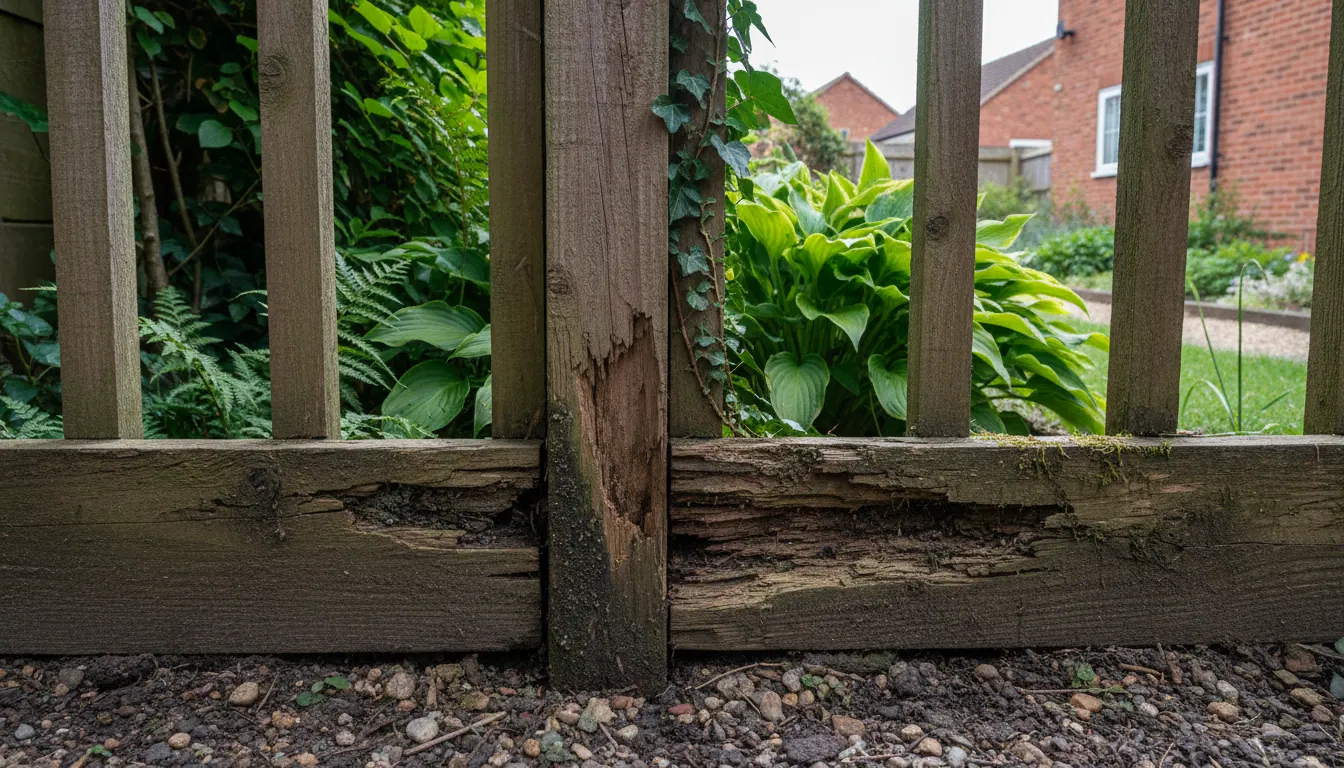
A fence post can look perfectly solid above ground and be crumbling away at the base. It happens all the time across Nottinghamshire and Lincolnshire, and the Trent Valley's heavy clay soil makes it worse than most places. Clay holds water around the post rather than draining away, keeping the timber wet for weeks at a stretch through autumn and winter. That constant moisture is exactly what wood-rotting fungi need to get established.
Most wooden fence posts fail at the same point: roughly 50 to 75 mm below ground level, right at the interface where damp soil meets the air. Above that line the timber dries out between rain showers. Below it, the post stays buried and relatively stable. At the join, moisture and oxygen combine to create the ideal conditions for rot. By the time the post wobbles noticeably, the damage is usually well advanced.
We see this regularly on properties across Newark, Southwell, Collingham and out towards Grantham and Sleaford. It is not a sign of poor-quality fencing necessarily. Even decent treated timber will eventually fail if the conditions are against it.
The most common reasons wooden fence posts rot in Nottinghamshire gardens
Soil contact and drainage. Clay-heavy ground across much of Nottinghamshire retains water. If posts were installed without a concrete spur or a proper concrete footing, the timber sits directly in wet soil year-round.
Insufficient treatment at the base. Pressure-treated timber is the standard now, but older fencing is often softwood that was brush-treated at best. The treatment penetrates only a few millimetres, so once the surface weathers or gets damaged, the raw wood underneath is exposed.
Post caps missing or damaged. Rain sits on a flat-topped post and soaks straight down the grain. A simple post cap or a chamfered (angled) cut at the top makes a real difference to how long a post lasts. Plenty of older fencing around Newark and the surrounding villages was installed without them.
Age and previous repairs. A fence that has been patched repeatedly over the years often has posts of mixed ages. One section might be ten years old, another twenty. The older posts start going, the fence leans, and the strain transfers to the next post along. We often find that what looks like one rotten post is actually three or four failing in sequence.
Ground movement. Nottinghamshire's clay soils shrink and swell with the seasons. A post that was plumb when installed can be pushed out of vertical by ground movement, opening up cracks in the wood that let moisture in.
How to spot a failing post before the fence falls over
Catching rot early saves a lot of work. Here is what to look for on your own fence:
- Discolouration at ground level. Dark staining or a greying, soft appearance where the post meets the soil is an early warning sign.
- The wobble test. Push the post firmly from side to side. A small amount of movement is normal; anything more than about 10 mm suggests the base has gone.
- Hollow sound. Tap the post with a screwdriver handle at ground level. A dull, hollow sound compared with the ring of sound timber above suggests internal rot.
- Visible cracking. Deep longitudinal cracks running down the post allow water in and accelerate rot significantly.
- Leaning panels. If fence panels are pulling away from the post fixings or sagging on one side, the post is likely already compromised.
Do this check in spring and again in autumn. Winter storms across Lincolnshire and Nottinghamshire put serious load on fence panels, and a post that was borderline in October may be flat on the ground by January. Our article on repair or replace: what to do with a damaged garden fence in Newark and Nottinghamshire covers the wider question of whether a fence is worth saving in more detail.
Wooden, metal or concrete: which post type suits Nottinghamshire conditions?
This is one of the most practical questions we get asked, and the honest answer is that each has its place.
Pressure-treated softwood is still the most common choice for domestic fencing across Newark, Bingham and the surrounding area. Modern treatment processes push preservative deep into the timber, and a quality post in a well-draining installation can last fifteen to twenty years. The key is installation: concrete around the base, a post cap fitted, and good drainage beneath.
Hardwood posts (oak, sweet chestnut) are more durable in contact with soil. Chestnut post-and-rail fencing is a traditional choice on rural properties and farms across Nottinghamshire and Lincolnshire, and for good reason. It is heavier to work with and the initial outlay is higher, but the lifespan in wet ground is considerably longer.
Metal fence post spurs (repair spurs) are a practical solution when the post is sound above ground but rotten at the base. A steel spur is concreted into the ground alongside the old post, and the post is bolted to it. This avoids removing the existing fence run and can be a sensible option where the panels and the upper section of the post are still in good condition. We use these regularly on jobs across the area.
Concrete posts are essentially rot-proof. They suit panel fencing well, and on a boundary that you want to set up and forget, they are worth considering. The main practical point is that they are heavier to handle and need to be set accurately first time, as adjusting a concrete post after the concrete has gone off is not straightforward.
For anything beyond a simple like-for-like post replacement, it is worth talking the options through before committing. We look at each job individually and quote accordingly once we understand the ground conditions, the length of run and what the fence needs to do.
What the repair job actually involves
A straightforward post replacement on a domestic fence in Nottinghamshire typically goes like this:
- Panels either side of the failed post are removed and set safely aside.
- The old post is dug or pulled out. On clay ground this can take effort, especially if the original concrete footing is substantial.
- The hole is cleared, deepened if needed and checked for drainage.
- The new post is set in concrete, checked for vertical and left to cure (usually 24 to 48 hours before load is applied).
- Panels are re-hung and checked for level.
Where multiple posts are going at once (which is common on fencing that was all installed at the same time), we often work along the run systematically. Taking down and re-erecting a long run is more disruptive but gives a much better result than patching individual posts one by one over several years.
For more detail on what is involved when panels themselves need replacing alongside the posts, take a look at our article on new fence panels and gravel boards: replacing the rotten bits without replacing the whole fence.
Frequently asked questions
Can I replace a fence post myself, or does it need a professional? A single post on flat, well-draining ground is a manageable DIY job if you are comfortable with post-hole digging and mixing concrete. The difficulty increases quickly on clay ground, where the hole tends to close in and water pools in the base. It also gets more complicated near boundaries shared with a neighbour, where any disturbance needs agreement. For longer runs or where the ground is awkward, calling us in usually saves time and avoids a fence that is back out of vertical within a season.
My fence is on a boundary with my neighbour. Who is responsible for the repair? Responsibility depends on the title deeds to your property, not on convention. The deeds show which boundary belongs to which party, usually indicated by a 'T' mark on the plan. If you are unsure, your solicitor's paperwork from when you bought the house is the place to look. We can replace fence posts and panels on either side of a boundary, but we always recommend sorting out the ownership question before work starts to avoid disputes later.
How long should fence posts last in Nottinghamshire's clay soil? Pressure-treated softwood posts, properly concreted in with good drainage at the base, should last fifteen years or more in most conditions. On very wet clay sites, or where posts were installed without concrete, ten years is a more realistic figure. Hardwood and concrete posts last considerably longer. Regular checks at the base help catch problems before a post fails completely.
Do I need planning permission to replace a fence in Nottinghamshire? In most cases, no. Replacing like-for-like on an existing boundary does not require planning permission. The main exceptions are fences over 1 metre high adjacent to a highway, fences over 2 metres elsewhere, and properties in a conservation area where permitted development rights may be restricted. If you are in any doubt, a quick call to Newark and Sherwood District Council or the relevant local authority before work starts is the sensible move.
Get in touch about rotting fence posts across Newark, Nottinghamshire and Lincolnshire
If your fence is leaning, posts are soft at the base, or you have a run of panels that have seen better days, we are happy to come and take a look. We cover Newark-on-Trent, Southwell, Collingham, Bingham, Lincoln, Grantham, Sleaford and the surrounding area. We quote each job individually once we have seen what is needed.
Call us on 07572 397309 and we will arrange a time to visit.