Repair or replace? What to do with a damaged garden fence in Newark and Nottinghamshire
Need garden fence repair in Newark or across Nottinghamshire? We fix broken panels, posts and gravel boards fast. Call us on 07572 397309.

Fences take a battering in the Trent Valley
If you live anywhere near Newark-on-Trent, you already know what the weather does to timber fencing. The Trent valley sits low, the winters are wet, and the wind picks up across open ground with very little to slow it down. A fence that looked solid in September can have a leaning post, a split gravel board or a panel hanging off its fixings by February.
We carry out garden fence repair across Newark, Southwell, Collingham, Bingham, Lincoln, Grantham, Sleaford and the wider stretch of Nottinghamshire and Lincolnshire in between. Whether it is a single blown panel or a whole run of fence that has shifted and rotted at the base, we can assess it honestly and get it sorted.
What actually goes wrong with garden fencing
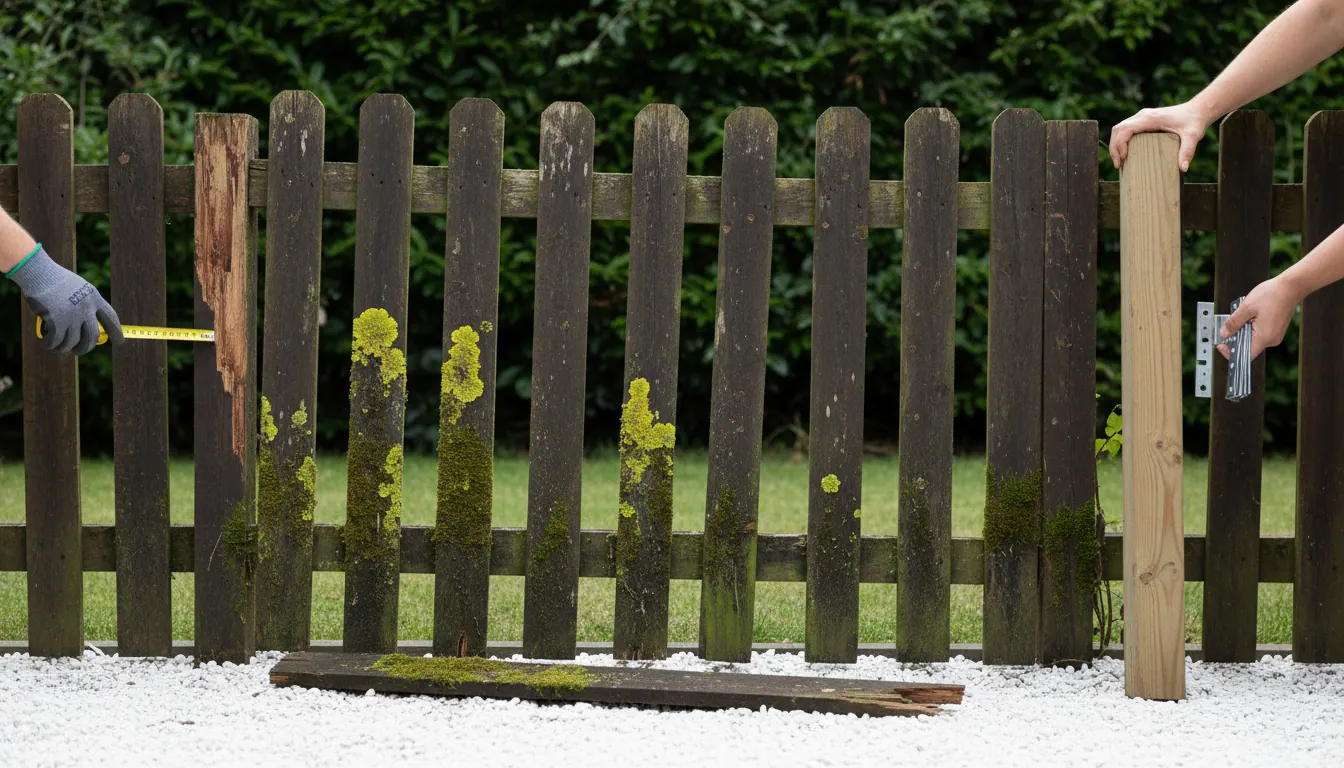
Most fence problems come down to one of three things: rotten or broken posts, failed gravel boards, or damaged panels. Understanding which part has failed matters, because it changes what the repair involves.
Fence posts are almost always the root cause of a leaning or collapsed fence. Timber posts rot from the base up, where they sit in the ground and hold moisture. Concrete posts last longer but can crack or lean if the ground shifts. A post that has gone at the base cannot be saved by nailing the panel back on.
Gravel boards sit along the bottom of the fence line, just above soil level. Their whole job is to take the moisture and rot so the panels above them do not have to. When they split or decay, panels start to go too. Replacing gravel boards is one of the most cost-effective repairs you can do, and it extends the life of perfectly good panels by years.
Fence panels themselves crack, warp or blow out in high winds. Lap panels in particular, the overlapping slat style common on most residential gardens across Nottinghamshire, are relatively lightweight and can be lifted clean out of their slots in a strong gust. Replacing a panel is straightforward if the posts are still sound.
We also repair close-board fencing, picket fencing, and post-and-rail setups common on rural properties and smallholdings around the Lincolnshire and Nottinghamshire borders.
Repair or replace? How we make that call
This is the honest conversation we have with every customer. Not every damaged fence needs to come down and start again, and we will not tell you it does if it does not.
A fence worth repairing has posts that are still solid at the base, straight and firmly set. If you can grab the top of the post and rock it, the post has gone. From there, it is usually more cost-effective to replace that section properly rather than patch around a failing post.
Signs a repair is the right call:
- One or two panels blown out but posts still firm
- Gravel boards rotted but the rest of the fence structurally sound
- A gate that has dropped or a latch that has failed
- Arris rails (the horizontal timbers that close-board fence sits on) split or pulling away
Signs a section needs replacing:
- Multiple posts rotten at the base
- The fence line has shifted or leaned significantly
- Panels and posts have both deteriorated together over a long run
We will always give you a straight answer on which applies to your fence before any work starts.
Garden fence repair costs: what affects the price
We do not publish a fixed price list because no two jobs are identical, and giving you a number that turns out to be wrong does not help anyone. What we can tell you is what drives the cost up or down.
What keeps costs down:
- Small number of panels or posts to replace
- Easy access along the fence line
- Standard lap panel or close-board style in common sizes
What adds to the cost:
- Multiple rotten posts requiring concrete removal and new post installation
- Difficult access (tight side passages, sloping ground, established planting against the fence)
- Bespoke panel sizes or styles
- Disposal of old timber
As a rough guide, replacing a single blown panel with a sound post either side is a relatively quick job. Replacing a run of posts involves digging out old concrete, setting new posts correctly and waiting for them to cure before the panels go back on, so that takes more time and materials.
We are happy to come out, look at what you have, and give you a written quote with no obligation. That is always the best way to get an accurate figure for your specific situation.
Boundary fences: whose responsibility is it?
This comes up on almost every fence job we do. The short answer is: it depends on your deeds, and the law does not automatically make one neighbour responsible.
Your title deeds or the transfer documents for your property should show which boundary belongs to which owner. The convention of "the fence belongs to the owner whose side the posts are on" is widely repeated but not a legal rule. It is worth checking your deeds before assuming.
In practice, most fence repairs we carry out are instructed by the homeowner who wants the fence fixed, regardless of the legal position. If there is a dispute about who should pay, that is a matter between neighbours or their solicitors. We are not in a position to arbitrate that, but we can make sure the work is done properly once you are ready to proceed.
One thing to be aware of: if you need to go onto your neighbour's property to carry out the repair, you do need their permission. You have no automatic right of access to their land, even to fix your own fence. Most neighbours are reasonable about this when asked politely, but it is worth having the conversation before we arrive on site.
Does planning permission affect fencing work?
For most straightforward repairs and like-for-like replacements, no. Replacing a damaged panel or post with the same style and height does not require planning permission.
However, if your property is in a conservation area (several parts of Newark town centre and surrounding villages fall within designated conservation areas), or if the fence is adjacent to a listed building, there can be restrictions on what you can do. Fences over a certain height near a highway can also require consent.
If you are unsure whether your property has any restrictions, it is always worth a quick check with Newark and Sherwood District Council or the relevant local authority before starting work. We can flag anything that looks like it might need attention when we come to quote.
For tree work near fences, permitted development rules can also come into play. Our article on whether you need permission to fell or prune a tree in Newark-on-Trent and Nottinghamshire covers the tree side of this in more detail.
Frequently asked questions about garden fence repair
How much does it cost to fix a garden fence in Newark?
There is no single answer, because it depends entirely on what has failed and how much of it. A single panel swap where the posts are sound is a relatively small job. Replacing several rotten posts along a 20-metre run, with concrete extraction and new gravel boards, is a much larger one. The only reliable way to get an accurate cost is to have someone look at the fence in person. We offer free, no-obligation quotes across Newark and the surrounding area, so get in touch and we will come and take a look.
Can I go into my neighbour's garden to fix my fence?
Not without their permission. Even if the fence is legally yours to maintain, you have no automatic right to enter someone else's property. In most cases a straightforward conversation with your neighbour resolves this, but you do need to ask first. If access is genuinely refused and it prevents the repair being carried out safely, that becomes a legal matter rather than a practical one.
Is my neighbour legally obligated to repair their fence?
Generally, no. There is no law in England that forces a homeowner to maintain a boundary fence in good repair, unless there is a specific covenant in the property deeds that says otherwise. If a neighbour's fence is in disrepair and causing a nuisance, the options are limited and usually involve checking the deeds first, then taking advice if needed. We are tradespeople rather than legal advisors, but we can confirm what the fence itself needs doing once the ownership question is settled.
How long does a fence repair take?
A straightforward panel or gravel board replacement on a single section can often be done in a morning. Post replacements take longer because new posts need to be set in concrete and allowed to cure properly before panels are reattached. We will always give you a realistic timescale when we quote.
We cover the whole area, not just one town
Our team works right across the patch: Newark, Southwell, Collingham, Bingham, Lincoln, Grantham, Sleaford and everywhere in between. We also cover rural properties, farms and smallholdings with longer fence runs and post-and-rail work. If you are not sure whether we cover your area, just ask.
We also handle full fence installations, garden clearance, hedge cutting and general garden maintenance, so if the fence repair is part of a bigger tidy-up, we can often take care of everything in one visit.
A damaged fence is one of those jobs that is easy to put off but gets more expensive the longer it sits. A leaning post left over winter will almost always take the panel with it by spring.
If you need garden fence repair in Newark or anywhere across Nottinghamshire and Lincolnshire, get in touch with us and we will arrange a time to come and have a look. No obligation, no hard sell, just a straight quote.