Conifer hedge and leylandii reduction: keeping your privacy screen without killing it
Expert conifer hedge reduction across Lincolnshire and Newark. We explain safe cutting limits, timing rules and what to expect from a professional trim.
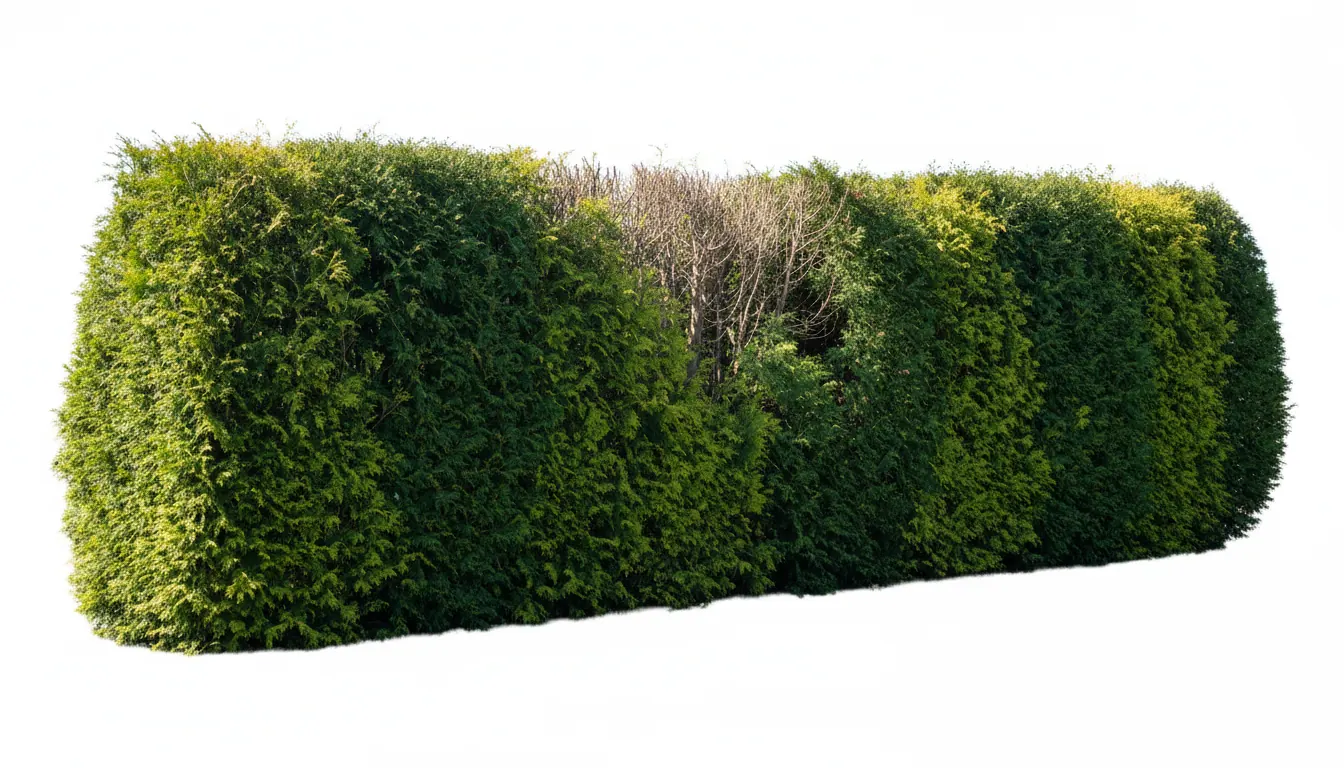
The problem with tall conifer hedges in Lincolnshire gardens
Leylandii grows fast. That is why so many homeowners across Lincoln, Sleaford, Grantham and the villages stretching out towards the Lincolnshire Wolds planted them in the first place. A quick boundary screen, a bit of privacy, a windbreak against the flat fenland gales. Twenty years later, the hedge is four metres tall, blocking the light from half the garden, and the question becomes: how do you bring it back without killing it?
It is a question we get asked a lot. And the honest answer is that conifer reduction is one of those jobs where the difference between a good outcome and a dead hedge comes down to knowing exactly how far back you can cut.
Why conifers are unforgiving when you cut too hard
Most garden hedging plants will regenerate from old wood. Beech, hornbeam, hawthorn, yew (a notable exception among conifers, as it does regenerate), cut them hard and they push new growth back from bare stems. Leylandii and most other fast-growing conifers do not work that way.
Cut back into the brown, dead zone behind the green foliage and the plant simply will not re-shoot. The brown stays brown. That is why you see so many ghostly, patchy hedges around Lincolnshire properties where someone has taken off too much in one go.
The rule of thumb we follow is to cut back only into actively green growth, leaving a reasonable buffer of live foliage on every branch. Never cut past the green into the dead wood behind it.
For height reduction specifically, this means:
- A modest reduction is achievable: typically 20 to 30 per cent of the overall height in a single season
- Anything more aggressive than that risks permanent die-back at the top
- The sides can generally be taken in further than the top, but the same principle applies
If a hedge has been allowed to grow well beyond what a single reduction can fix, it is sometimes better to take it out completely and replant with a more manageable species. We can advise on that when we come to assess the job.
When is the right time of year to cut a conifer hedge in Lincolnshire?
Timing matters, and there are two separate sets of rules to keep in mind.
For the best results on the plant, late summer (August into early September) is generally ideal for a main trim. The hedge has put on its season's growth, the cut ends have a few weeks to dry and settle before winter, and you avoid stimulating a flush of soft new growth that could be caught by early frosts. A light tidy in late spring (May or early June) is fine for minor shaping.
For the law, you need to think about nesting birds. It is not strictly illegal to cut hedges between March and August, but the Wildlife and Countryside Act 1981 makes it an offence to intentionally damage or destroy an active bird's nest. In practice, that means any hedge work between March and August carries a real risk if birds are nesting inside it.
Our advice: if it is not urgent, plan the main reduction for late summer or autumn. If you need work done between March and August, we will always carry out a careful check before we start. We cover this in more detail in our article on bird nesting season rules for Newark and Nottinghamshire, the same rules apply across Lincolnshire.
Conifer hedge reduction across our Lincolnshire service area
We work across a wide patch of Lincolnshire and Nottinghamshire, covering Lincoln, Sleaford, Grantham, Collingham, Southwell, Bingham and the villages in between. That includes a lot of rural and semi-rural properties where conifer hedges form the backbone of the garden's structure.
In the more exposed spots, particularly out towards the Lincolnshire Wolds villages or on open farmland, these hedges do a real job as windbreaks. Taking too much off at once can actually reduce their effectiveness as shelter belts, so we factor that in when we're planning the work.
For gardens in Lincoln, Sleaford or Grantham where the issue is more about light and overlooking, the approach is slightly different. Here the priority is usually bringing the height back to a manageable level over two or three seasons, rather than trying to do it all in one cut.
What does conifer hedge reduction actually involve?
When we come to carry out a reduction, the process is more involved than a simple trim with a hedge cutter.
For tall hedges (anything above head height), we work from platforms or ladders, and for very tall or wide hedges we may use a tracked lift. The top of the hedge needs to be cut cleanly and level, with the sides tapered slightly so light reaches the lower growth and the base stays dense.
All the arisings (the cut material) are chipped or removed from site. Conifer clippings are bulky and heavy, so this is a significant part of the job.
A typical reduction on a mature leylandii hedge running along a garden boundary will take a half day to a full day depending on the length and height involved. We always clear up fully before we leave.
Can a conifer hedge become a legal issue?
Possibly, yes. The High Hedges legislation under the Anti-social Behaviour Act 2003 gives councils the power to order a reduction in hedge height where a tall evergreen hedge is blocking light to a neighbour's property. Lincolnshire councils, like Nottinghamshire councils, do deal with these complaints.
If your hedge has become a source of dispute with a neighbour, it is worth knowing that a professional reduction, carried out to a reasonable and agreed height, often resolves things before they reach a formal complaint stage. We are happy to discuss what a sensible target height would be for your particular hedge.
Frequently asked questions
How much does it cost to have a conifer hedge reduced in Lincolnshire?
There is no single answer because the price depends on the length of the hedge, its current height, how much access there is, and how much material needs to be removed and chipped. A short garden hedge might take a couple of hours; a long boundary hedge running the full length of a rural property could be a full day's work for two people. The best thing to do is call us for a free quote. We cover Lincoln, Sleaford, Grantham and the surrounding area and can usually come out to assess without delay.
How much height can actually be taken off a conifer hedge without killing it?
As a general guide, you should only cut back into wood that still carries green foliage. For most leylandii and similar conifers, that means a reduction of around 20 to 30 per cent of total height is achievable safely in one season. If the hedge has grown far beyond that, a staged reduction over two or three years is the more sensible route. Cutting past the green into bare brown wood almost always results in permanent die-back at the top.
Is it against the law to cut hedges between March and September?
Not outright, but it is an offence under the Wildlife and Countryside Act 1981 to disturb or destroy an active bird's nest. Because birds nest in hedges from roughly March through to August, cutting during that period carries a genuine legal risk. We always check for active nests before starting any hedge work during those months. Outside that window, there are no restrictions for standard garden hedges (though different rules apply to hedges in conservation areas or on the boundary of a Site of Special Scientific Interest).
What is the best time of year to cut a conifer hedge in Lincolnshire?
Late summer, from late August into September, is generally the best window. The hedge has finished its main growing season, the weather is usually settled, and the cuts have time to dry before the colder months arrive. A light tidy-up in late May or early June is also fine for minor shaping. Avoid cutting in very cold or frosty conditions, as this can cause die-back at the cut ends.
Other garden and tree work we carry out across Lincolnshire and Nottinghamshire
Conifer reduction is one part of what we do. Across our service area we also handle full tree removal and stump grinding, crown reduction on mature garden trees, fencing and fence panel replacement, garden clearance on overgrown plots, and driveway and patio pressure washing.
If a tree stump is left behind after removal, it can cause real problems for any subsequent landscaping work. Our article on stump grinding after tree removal explains why it is worth dealing with before you lay a new patio or put up a fence.
We cover Newark-on-Trent, Lincoln, Sleaford, Grantham, Southwell, Collingham, Bingham and all the towns and villages within roughly 25 miles of Newark.
Get in touch for a conifer hedge reduction quote
If you have a tall conifer hedge that needs bringing back under control, the sooner you get it assessed the better. Leaving it another season just means more growth to deal with and a harder job all round.
Call us on 07572 397309 to arrange a free, no-obligation quote. We will come and look at the hedge, give you an honest assessment of what can be achieved and when, and price the job fairly. No pressure, no hard sell.