Crown reduction vs tree removal: which is right for your Newark garden?
Learn when crown reduction is the right choice for your trees in Newark, Nottinghamshire and Lincolnshire. Practical advice from your local tree surgeons.
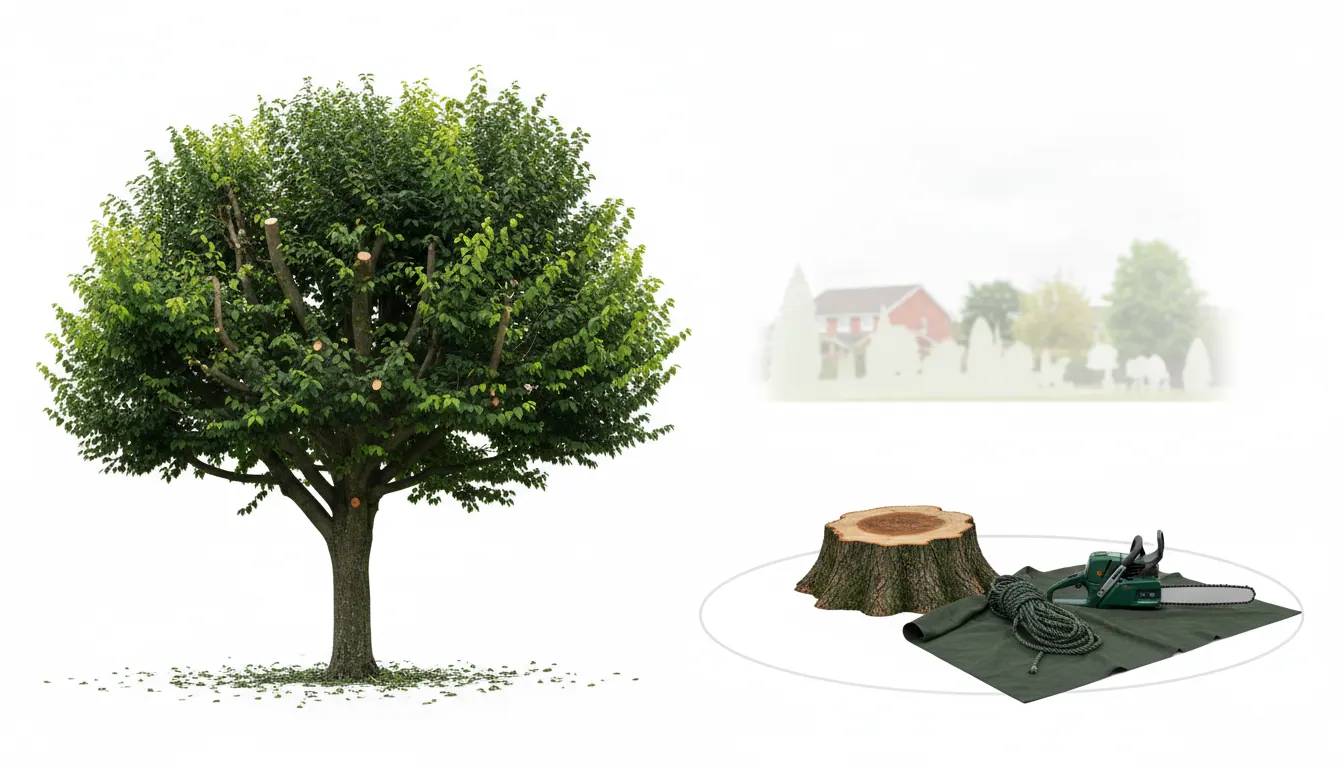
What crown reduction actually does to a tree
A heavy, overextended canopy is one of the most common problems we see on mature trees across Newark, Southwell, Collingham and the surrounding villages. The tree is not necessarily unhealthy. It has simply outgrown its space, and now it is shading the garden, pressing against roof tiles, or swaying uncomfortably close to a fence in a winter gale.
Crown reduction is the answer in many of those situations. Put simply, it reduces the overall size of the canopy by shortening the outer branches back to a suitable growing point. Done properly, the tree keeps its natural shape. The branch structure stays intact. You end up with something that looks like a slightly smaller version of what was there before, not a butchered stump.
That last point matters. A lot of people confuse crown reduction with topping, which involves cutting straight across the main stems regardless of where the growth points are. Topping causes serious long-term damage. Crown reduction, carried out to British Standard BS 3998, does not. If a contractor cannot explain that difference clearly, that is a red flag.
When crown reduction is the right choice (and when it is not)
Crown reduction suits trees that are structurally sound but have simply grown too large for their position. We carry it out regularly on oaks, ash, beech, birch, walnut and maple trees across the Trent valley, as well as on ornamental species in domestic gardens in places like Bingham, Farndon and Balderton.
It tends to be the right call when:
- The canopy is blocking light to the house or garden but the tree itself is worth keeping
- Branches are getting close to buildings, gutters or overhead cables
- The tree is creating wind resistance that puts strain on roots in wet, soft ground (a real concern in the Trent flood plain)
- You want to reduce the visual bulk without losing the tree entirely
- A neighbour's tree is overhanging your property and you want a proportionate solution rather than a dispute
It is not the right answer if the tree is structurally compromised, heavily diseased, or in a position where it genuinely cannot be managed safely long term. In those cases, removal and stump grinding may be the more honest advice. We will always tell you which applies.
Crown reduction in conservation areas and TPO trees
Before any work starts, it is worth checking whether your tree has a Tree Preservation Order (TPO) or sits within a conservation area. Newark-on-Trent has several conservation areas, and villages such as Southwell and Collingham have significant numbers of protected trees.
If your tree is covered by a TPO or sits in a conservation area, you need to notify Newark and Sherwood District Council (or the relevant authority for Lincolnshire trees) at least six weeks before work begins. You are not necessarily refused permission. The council needs the opportunity to assess the proposal. Crown reduction is often approved where removal would not be.
We can advise on what information a notification typically needs, though we do not produce formal arboricultural reports. For a fuller guide to the permission question, our article on whether you need permission to fell or prune a tree in Newark-on-Trent and Nottinghamshire covers this in detail.
What crown reduction looks like before and after
Before the work, the tree typically has long, whippy outer branches that extend well beyond the main framework. The canopy looks heavy and uneven. In winter, without leaves, you can often see how far the outer growth has run beyond the structural scaffold.
After a proper reduction, the outer branches are shortened back to lateral growth points. The silhouette is smaller and tidier, but the branch architecture is still recognisably the same tree. New growth will come from those cut points the following season, which is why a well-done reduction can last several years before a follow-up visit is needed.
The difference between a good job and a poor one is almost entirely about where the cuts are made. Cutting to a growing point allows the tree to seal over the wound and direct energy into the remaining branch. Cutting blindly into the middle of a branch leaves a stub that rots, weakens and eventually fails.
Crown reduction vs crown lifting: which does your tree need?
These are two separate operations and they solve different problems. Crown reduction brings the whole canopy inward, reducing height and spread. Crown lifting removes the lower branches to raise the base of the canopy, improving clearance underneath.
If the issue is branches scraping a car roof or blocking a pavement, crown lifting is probably what you need. If the issue is the tree being too tall or too wide overall, crown reduction is the right approach. Sometimes both are needed together, particularly on large, mature trees in village gardens around Grantham, Sleaford or Lincoln where the tree has been left unmanaged for many years.
Crown lifting is generally quicker and less disruptive than a full reduction. It also tends to cost less. The downside is that it does nothing about overall height or spread. For trees that are genuinely too dominant for their position, lifting alone is not enough.
Timing: when is the best time for crown reduction?
Most crown reduction work is carried out in late autumn and winter, when the tree is dormant and leafless. Working without leaves makes it much easier to see the branch structure clearly and make accurate cuts. It also puts less stress on the tree.
That said, we do carry out reductions year-round where there is a genuine need, such as after storm damage or where branches pose an immediate risk. One timing restriction worth knowing: between roughly March and August, nesting birds may be present in the canopy. Disturbing an active nest is an offence under the Wildlife and Countryside Act 1981. We always check before cutting during that period.
How much does crown reduction cost in Nottinghamshire and Lincolnshire?
Pricing depends on several factors: the size and species of the tree, how accessible it is, how much material needs to come out, and whether the site is straightforward or complicated by proximity to buildings, power lines or roads.
Small ornamental trees in a domestic garden cost considerably less than a mature oak or ash in a tight village plot. A tree that can be worked from the ground or with a small platform is cheaper than one requiring a full aerial rigging operation.
We always visit before quoting. A price given over the phone without seeing the tree is not one we would trust, and we would not give one ourselves. If you are getting quotes from several contractors, make sure they are all specifying the same scope of work and that they hold the appropriate insurance and qualifications.
Winter is often a good time to book: demand is lower than in spring and summer, and some customers find they can get work scheduled more quickly in the quieter months.
Frequently asked questions
What does crown reduction look like on a tree? After a proper reduction, the tree looks like a smaller, tidier version of itself. The outer branches are shortened back to natural growing points, so the shape is preserved. What you should not see is flat-topped cuts across main stems or bare stubs sticking out from the framework. If a finished tree looks like it has been roughly lopped rather than carefully shaped, the work was not done to the correct standard.
How much does it cost to reduce a tree crown in the UK? There is no single answer because size, species, access and location all affect the price significantly. A modest garden tree might cost a few hundred pounds. A large, mature specimen in a difficult position will cost considerably more. The only reliable way to get a fair price is to have the tree assessed in person. We offer free, no-obligation quotes across Newark, Nottinghamshire and Lincolnshire.
What are the pros and cons of crown lifting compared to crown reduction? Crown lifting is faster, less expensive and improves clearance underneath the tree without changing its overall height or spread. It works well where the problem is low branches rather than general bulk. Crown reduction addresses overall size but is a bigger job. The downside of reduction is that it requires more careful, skilled cutting to avoid long-term damage. Done badly, it can shorten a tree's life. Done well, it extends it.
Can I make my neighbour reduce the height of their trees? You have the legal right to cut back branches that overhang your property to the boundary line, at your own cost, and you must offer the cut material back to the tree owner. However, you cannot compel a neighbour to reduce their trees on your behalf unless the trees are causing a legal nuisance. If the trees are protected by a TPO, even cutting overhanging branches needs care. It is always worth talking to the neighbour first. If the trees genuinely need professional attention, we are happy to discuss the situation with both parties if that helps.
If you have a tree that is outgrowing its space or you are not sure whether reduction, lifting or removal is the right call, get in touch with us. We cover Newark-on-Trent, Southwell, Collingham, Bingham, Lincoln, Grantham, Sleaford and everywhere in between. Call us on 07572 397309 and we will arrange a visit to take a look.