Storm damage to trees: what to do after autumn gales in Newark and Lincolnshire
Storm damaged a tree in Newark, Nottinghamshire or Lincolnshire? Here's exactly what to do, who's liable, and when to call a tree surgeon.

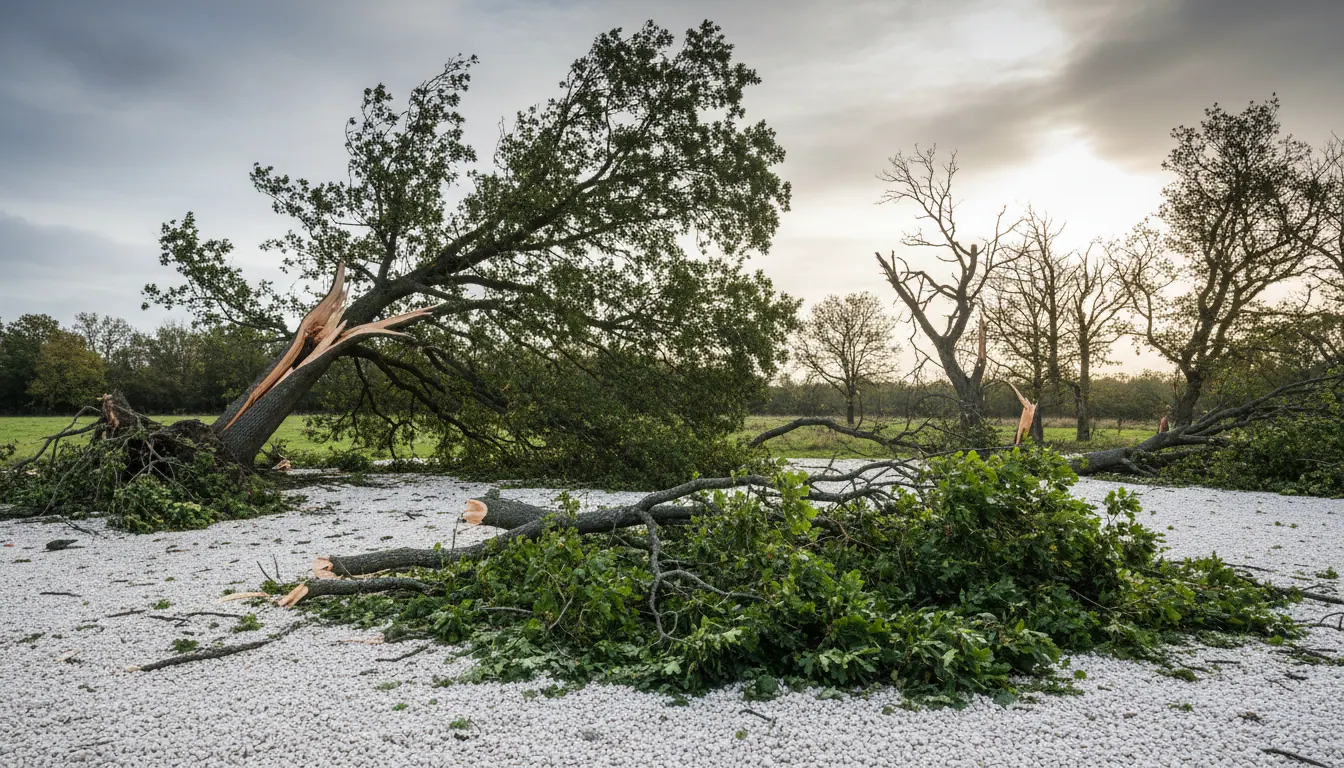
A split tree, a leaning trunk, a blocked drive. What now?
Autumn gales and winter storms roll through the Trent valley with real force. If you wake up to a tree that's split, shed a major limb, or come down completely, the first instinct is often to grab a chainsaw or start pulling branches away. Stop. Storm-damaged trees are unpredictable in ways that healthy ones are not, and getting it wrong can be genuinely dangerous.
This guide covers exactly what to do in the hours and days after a storm hits a tree on your property, across Newark-on-Trent, Southwell, Collingham, Bingham, Lincoln, Grantham, Sleaford and the wider Nottinghamshire and Lincolnshire area.
Step one: stay back and assess from a safe distance
Before you touch anything, look at the whole picture. A tree that has partially fallen may be under enormous tension. Branches caught in the canopy of neighbouring trees, known as "widow makers", can drop without warning. Root plates that have lifted may spring back. Power lines that look clear may be in contact higher up.
Walk around the tree from a distance. Look for:
- Cracks or splits running down the main trunk
- Major limbs hanging or suspended in other branches
- Roots lifting on one side
- Contact with overhead cables or structures
- Damage to fences, walls, a vehicle, or a neighbouring property
If any of those apply, treat it as an emergency. Keep children and pets well away and call us straight away on 07572 397309. We cover emergency call-outs across Newark and the surrounding area.
Is it a genuine emergency or can it wait?
Not every storm-damaged tree needs immediate attention. Here's a rough guide.
Act immediately if:
- The tree or a large limb is resting on a building, vehicle, or power line
- The tree is blocking a road or access route and creating a hazard
- The trunk has split to ground level and the tree is visibly unstable
- There is any risk to people passing nearby
It can usually wait 24-48 hours if:
- A smaller branch has come down in open garden space
- The tree is leaning but appears stable and is not near structures
- The damage is cosmetic: torn bark, minor splits in secondary branches
Even in the second category, get a professional assessment before doing any work. What looks stable from the ground may not be once someone is up in the canopy.
Who is liable for damage caused by a storm-damaged tree?
This is one of the most common questions we hear, and the honest answer is that it depends on a few things.
If a tree on your land falls and damages a neighbour's fence, car, or property, liability generally hinges on whether you knew, or should have known, the tree was in poor condition. If the tree was healthy and the damage was caused purely by an exceptional storm, that is typically treated as an act of nature and your neighbour would claim on their own insurance. If the tree was visibly diseased, dead, or had been flagged as a concern and nothing was done, the picture changes.
The practical takeaway: if you have trees on your land, especially mature oaks, ash, beech or any large specimen, get them inspected periodically. A healthy, well-maintained tree is your best defence against a liability claim. It also means you're not the person on the phone to us at 7am after a storm, wondering whether the fallen elm was your responsibility all along.
For full detail on permission requirements before doing any tree work, including felling, our article Do I need permission to fell or prune a tree in Newark-on-Trent and Nottinghamshire? is worth reading before you start any clearance work.
What happens after a tree is blown down by wind?
Once the immediate danger is managed, the process typically goes like this.
1. Make the site safe. We remove hanging limbs, cut back anything under tension, and secure the area.
2. Assess the remaining tree. Sometimes only part of a tree has failed. The root system and remaining trunk may be perfectly sound. A crown reduction or reshaping can save the tree entirely and restore its structure over time.
3. Decide: save or remove? We'll give you an honest opinion. Species matters here. A young oak or beech that has lost a major limb in a storm often recovers well with the right pruning. An older ash that is already showing signs of ash dieback is a different conversation. We never push for removal if the tree can be retained safely.
4. Clear the timber and brash. We chip or remove all arisings, leaving the site clean.
5. Consider the stump. If the tree is removed, stump grinding is the cleanest finish, particularly if you're planning new fencing, turfing, or a patio in that area.
For context on removal costs, our article How much does tree removal cost in Newark and Nottinghamshire? explains what affects the price.
Can a tree recover after being struck by lightning?
Yes, sometimes. Lightning damage varies enormously. A glancing strike might strip bark down one side and scorch foliage, but the tree's vascular system can remain largely intact. A direct strike that splits the trunk or explodes the heartwood is a different matter.
Signs a struck tree may recover:
- The strike has removed bark on one side but the crown looks otherwise intact
- New growth appears in the weeks following the strike
- The root system is undamaged
Signs it probably won't:
- The trunk has cracked or split at the point of strike
- The crown has died back significantly by midsummer
- The wood shows extensive internal damage when inspected
A professional assessment after a lightning strike is always worthwhile, particularly for valuable specimens. Some trees, especially mature oaks, are worth trying to save. Others need to come down before they become a hazard.
Tree Preservation Orders and storm damage in Nottinghamshire
This catches people out. If a tree on your property is covered by a Tree Preservation Order (TPO), or sits within a conservation area, you normally need permission before carrying out any work, including storm-damage clearance. There is an exception for urgent safety work, but it is narrowly defined and you should notify your local planning authority as soon as practically possible.
Nottinghamshire has a significant number of TPO trees, particularly in villages like Southwell, Farndon, and Collingham, and in conservation areas around Newark itself. If you're not sure whether your tree is protected, check with Newark and Sherwood District Council or Lincolnshire County Council before we start work. We can advise on this when you call.
Frequently asked questions
Who is responsible if a neighbour's tree falls on my property?
Generally, your neighbour is not automatically liable just because the tree is theirs. If the tree was healthy and the storm was severe, you would normally claim on your own buildings or contents insurance. If the tree was visibly dead, diseased, or your neighbour had been warned about its condition and did nothing, liability becomes more likely. If you're unsure, speak to your insurer first.
Do I need permission to fell a storm-damaged tree?
Possibly, yes. If the tree has a TPO or is in a conservation area, you need to notify the local planning authority even for emergency work. If the tree is neither protected nor in a conservation area, you generally do not need permission to fell it on your own land, but always check before starting work. Our article on permission to fell or prune a tree in Newark-on-Trent and Nottinghamshire covers this in detail.
What if a large branch has come down near my house but the tree is still standing?
Don't assume the remaining tree is safe. A partial failure can leave other limbs under altered tension, and the root system may have been disturbed. Get a professional to inspect the whole tree, not just the fallen section, before you carry out any clearance underneath it.
Can I cut up and remove the fallen wood myself?
For small branches in open space, yes, with care. For anything involving a chainsaw near a structure, near a road, or where the wood is under tension, please don't. Chainsaws and compressed timber are a serious combination. We carry full public liability insurance and the right equipment for exactly this kind of work.
Get in touch after a storm
If you've got a tree down, a split trunk, or a leaning specimen anywhere across Newark-on-Trent, Southwell, Collingham, Bingham, Lincoln, Grantham, Sleaford or the surrounding area, give us a call. We'll tell you honestly what needs doing, what can wait, and what the options are.
Call us on 07572 397309 and we'll get someone out to you.